

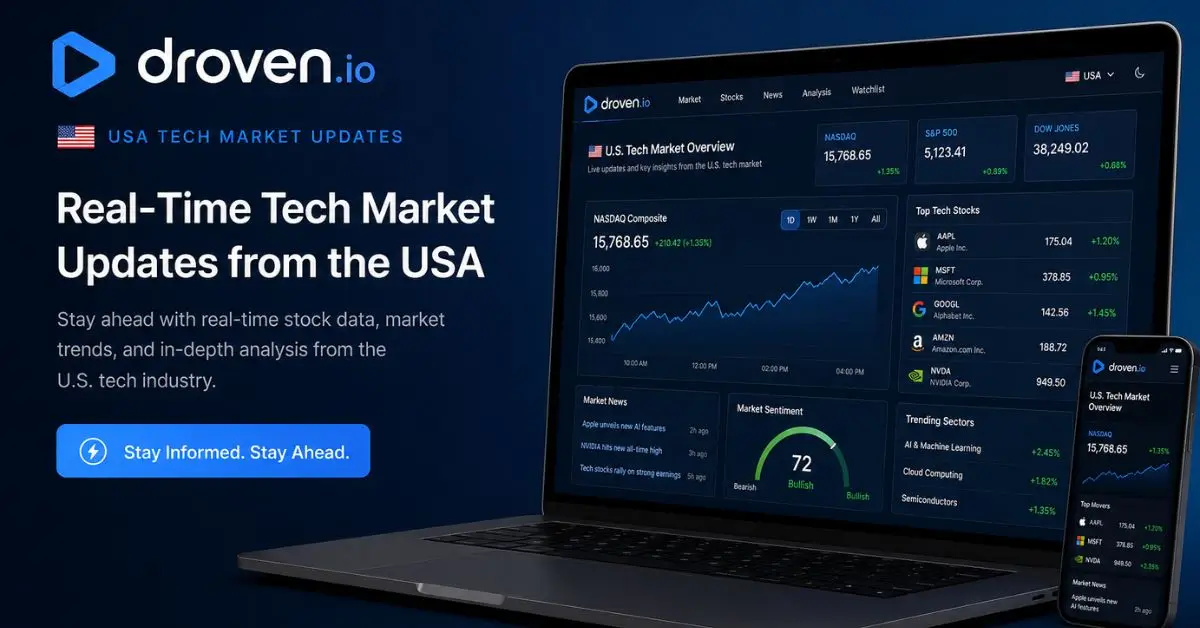
Droven.io USA Tech Market Updates: What Is Happening and Why It Matters
The US technology market is the largest and most influential technology ecosystem in the world. What happens in Silicon Valley, Seattle, New York, and Austin ripples outward through global supply chains, investment flows, regulatory frameworks, and technology adoption patterns that affect businesses and professionals far beyond American borders.
Staying current with US tech market developments is not optional for anyone whose work, investments, or strategic planning intersects with technology in any meaningful way. The challenge is that the volume of available market information is enormous, its quality varies significantly, and most coverage focuses on announcements rather than implications. Understanding what happened is less valuable than understanding what it means and what it signals about what is coming next.
That is the gap that platforms like Drovenio fill. By providing structured, contextual US technology market updates, droven.io usa tech market updates coverage helps businesses, investors, and technology professionals cut through announcement noise and focus on the developments that carry real strategic significance.
This guide covers the key sectors and themes in current US technology market activity, what the significant recent developments mean for different stakeholders, and how to use technology market intelligence effectively for real business and professional decisions.
Droven.io USA tech market updates refers to the current US technology market intelligence and industry analysis published through the Drovenio platform, covering developments across major technology sectors including artificial intelligence, cloud computing, cybersecurity, semiconductor technology, consumer electronics, and digital policy that shape the competitive landscape, investment environment, and strategic opportunities in the American technology market.
Quick Summary
Drovenio’s USA tech market updates cover current developments across AI, cloud, cybersecurity, semiconductors, and digital policy in the American technology market. This guide explains what is happening in each sector, why it matters, and how to use this market intelligence for better business and professional decisions.
Why US Technology Market Intelligence Matters Beyond the US
Before getting into specific sector developments, understanding why US technology market updates matter to readers in the UK, Canada, and other international markets alongside their obvious relevance to US-based businesses and professionals is worth establishing clearly.
The US technology market sets patterns that other markets follow, typically with a lag of one to three years. Regulatory approaches to AI, data privacy, and platform competition that emerge first in US policy debates become templates for legislation in other jurisdictions. Enterprise software adoption trends that take hold in large US organizations reach mid-market companies in the UK and Canada as those platforms scale their international operations. Technology sector valuations and investment patterns in the US venture capital market affect startup funding availability globally because of how interconnected institutional capital flows are.
For UK and Canadian businesses watching droven.io usa tech market updates, the coverage is not merely informational curiosity. It is forward-looking intelligence about what technology products, competitive dynamics, regulatory pressures, and operational tools they will likely be managing in their own markets within the next two to four years.
This forward-looking value is precisely why international readers constitute a significant and serious portion of the audience for US technology market coverage.
Artificial Intelligence: The Dominant Force in Current US Tech Market Activity
No sector is reshaping the US technology market more profoundly or more rapidly than artificial intelligence. The pace of AI development, adoption, and commercialization in the American market over the past two years has exceeded projections made by technology analysts as recently as 2022, and the implications are being felt across virtually every industry vertical.
Enterprise AI Adoption
Large US corporations are moving from AI experimentation to AI deployment at a pace that is creating competitive separation between organizations that have built genuine AI capabilities and those still evaluating. The productivity gains being reported from early enterprise AI deployments in knowledge-intensive sectors including legal, financial services, healthcare, and professional consulting are significant enough that organizations delaying adoption are beginning to experience measurable competitive disadvantage.
A practical example: a major US law firm that deployed AI-powered contract review tools reports reducing the time required for standard contract analysis by sixty to seventy percent without reducing accuracy. Competing firms watching those results are now accelerating their own AI evaluation timelines because the competitive pressure is becoming tangible rather than theoretical.
AI Infrastructure Investment
The infrastructure investment supporting US AI development represents one of the largest capital expenditure cycles in technology history. Data center construction, semiconductor demand, power infrastructure development, and networking hardware investment are all running at historically high levels driven by AI compute requirements.
This infrastructure investment has direct market implications for investors tracking the semiconductor sector, for utilities managing power demand increases from new data centers, and for cloud platform providers competing to capture AI workload revenue from enterprise customers.
AI Regulation and Policy
The US federal approach to AI regulation is evolving quickly and inconsistently across different government agencies, creating compliance uncertainty for businesses deploying AI systems. The current regulatory environment is more permissive than European frameworks but is tightening in specific high-risk application areas including hiring, credit scoring, healthcare diagnostics, and law enforcement.
Understanding the current and anticipated regulatory trajectory for AI in the US is important not just for US companies but for international organizations whose AI-powered products and services reach American customers and therefore come within the scope of US regulatory jurisdiction.
Cloud Computing: Market Consolidation and the AI Convergence
The US cloud computing market continues to consolidate around three dominant providers, Amazon Web Services, Microsoft Azure, and Google Cloud, while the competitive dynamics among them are shifting as AI capabilities become the primary differentiator for enterprise cloud platform selection.
The integration of AI services into core cloud infrastructure is changing how enterprises evaluate cloud platforms. Organizations that previously chose cloud providers based on compute cost, reliability, and existing integration ecosystems are now factoring in AI service quality, model availability, and AI development tooling as primary selection criteria.
This shift creates significant market movement as enterprises renegotiate cloud contracts and redistribute workloads to align with AI-optimized platform choices. For technology vendors and software companies that build on cloud infrastructure, the platform preferences of their enterprise customers are changing the ecosystem dynamics they operate within.
Edge Computing Growth
Alongside centralized cloud AI, edge computing infrastructure is growing as AI processing requirements push compute capacity closer to the data sources and decision points where AI inference actually needs to happen. Industrial AI applications, autonomous systems, and latency-sensitive applications are all driving edge infrastructure investment that represents meaningful market growth separate from core cloud expansion.
Cybersecurity: The Market Growing Fastest From the Most Difficult Problem
US cybersecurity spending is growing faster than almost any other technology category, driven by an escalating threat environment that is itself being shaped by the same AI capabilities transforming other sectors. AI-powered attack tools have lowered the skill barrier for sophisticated cyber attacks while increasing their volume and their ability to adapt to defensive measures.
The cybersecurity market implications are significant. Traditional signature-based and rule-based security tools are becoming less effective against AI-augmented threats, driving demand for AI-powered defensive security platforms that can operate at the speed and scale required to match increasingly automated attacks.
For US businesses, cybersecurity is no longer a purely IT spending decision. It is a board-level risk management priority with direct implications for cyber insurance costs, regulatory compliance requirements, and the growing legal exposure from data breach incidents.
Regulatory Pressure Driving Spending
US cybersecurity regulation is becoming more prescriptive across multiple sectors. Financial services, healthcare, critical infrastructure, and increasingly any organization doing business with US government entities face specific cybersecurity requirements backed by meaningful enforcement mechanisms.
This regulatory pressure is a consistent growth driver for the cybersecurity market regardless of broader technology spending cycles, because compliance-driven security investment is less discretionary than capability-driven investment during economic uncertainty.
Semiconductors: The Strategic Technology Market
The US semiconductor sector is undergoing its most significant structural change in decades, driven by a combination of government industrial policy through the CHIPS Act, reshoring of manufacturing capacity, and the extraordinary demand surge created by AI compute requirements.
New US semiconductor manufacturing facilities coming online in Arizona, Ohio, and Texas represent a genuine shift in where advanced chip manufacturing happens, with implications for supply chain security, technology export controls, and the competitive position of US technology companies that depend on semiconductor access.
For technology companies of all sizes, semiconductor availability and pricing directly affects product development timelines, bill of materials costs, and the feasibility of hardware-dependent technology strategies.
Export Controls and Geopolitical Impact
US technology export controls affecting semiconductor sales to specific markets are reshaping global technology supply chains and creating both constraints and opportunities for US technology companies and their international competitors. Understanding these policy dynamics is increasingly important for technology market analysis that goes beyond pure product and financial metrics.
Consumer Technology: Market Signals From the World’s Largest Consumer Tech Market
The US consumer technology market provides leading signals about global adoption trends for new device categories, software platforms, and consumer digital services. What US consumers adopt today tends to reach other English-language markets within one to two years and broader global markets within three to five years.
Current US consumer technology market activity shows continued smartphone market maturity with modest upgrade cycles, significant growth in AI-enhanced consumer applications, and early but meaningful interest in augmented reality applications as device capabilities improve.
The subscription economy in consumer technology continues expanding as major platforms shift from one-time purchase models to recurring revenue relationships with their user bases, creating ongoing consumer spending commitments that are increasingly significant household expenses across income levels.
US Tech Market Sector Summary
| Sector | Current Trend | Growth Direction | Key Driver | Risk Factor |
|---|---|---|---|---|
| Artificial Intelligence | Rapid enterprise adoption | Very high | Productivity gains and competitive pressure | Regulatory uncertainty |
| Cloud Computing | AI convergence reshaping selection | High | AI workload demand | Provider consolidation |
| Cybersecurity | AI-driven threat escalation | Very high | Regulatory requirements and threat growth | Talent shortage |
| Semiconductors | Manufacturing reshoring | High | CHIPS Act and AI demand | Geopolitical risk |
| Consumer Technology | Maturity with AI enhancement | Moderate | AI feature integration | Upgrade cycle fatigue |
| Digital Policy | Increasing regulation | Moderate | AI risk concerns | Policy fragmentation |
How to Use US Tech Market Intelligence Effectively
Understanding what droven.io usa tech market updates covers is most valuable when combined with a practical approach to actually using that intelligence for decisions and planning.
Connect market trends to your specific situation. A US tech market trend that is irrelevant to your industry or business model requires less of your attention than one that directly affects your competitive environment, your technology stack, or your regulatory obligations. Reading market updates with your specific situation in mind filters noise more effectively than trying to track everything equally.
Distinguish between signal and noise in market coverage. Not every technology announcement represents a genuine market shift. Many technology news items are marketing events dressed as market developments. The question to ask about any market update is whether it changes something that affects real decisions rather than whether it is interesting as a technology development in isolation.
Use market intelligence for forward planning rather than reactive response. The highest value of technology market updates comes from using trend information to anticipate what your competitive environment, your technology options, and your regulatory obligations will look like in twelve to twenty-four months, not just understanding what has already happened. Forward-looking use of market intelligence consistently produces better strategic decisions than purely retrospective analysis.
Cross-reference significant developments across multiple credible sources. Market intelligence from any single platform, including Drovenio, is most valuable when it can be cross-referenced with other credible sources for significant developments. Patterns that appear consistently across multiple reliable sources represent more certain market signals than developments reported by only one platform.
Conclusion
The US technology market moves fast, and the gap between organizations that track these developments deliberately and those that catch up reactively is growing in strategic importance across industries. Platforms like Drovenio that provide structured, contextual US tech market intelligence serve a genuine need for businesses and professionals who need to make decisions in environments shaped by technology market dynamics.
Use market updates not just to know what is happening but to understand what it signals about what is coming and what it means for the decisions you need to make over the next twelve to twenty-four months. That forward-looking use of market intelligence is consistently more valuable than purely retrospective awareness.
If you want to go deeper, explore our guide on how to use technology market intelligence for business strategy or our practical breakdown of the AI market developments most likely to affect US businesses in the next year. Both offer the same grounded, practically oriented approach to technology market analysis that this article is built on.
Frequently Asked Questions
What does Drovenio cover in US tech market updates?
Drovenio covers AI, cybersecurity, cloud computing, semiconductors, consumer tech, and digital policy with practical market insights.
Why does the US technology market matter globally?
US tech trends often influence global markets, helping businesses prepare for future changes and opportunities.
Which US tech sector is changing the fastest?
Artificial intelligence leads the biggest changes, followed by semiconductor manufacturing and cloud technologies.
How often should I follow tech market updates?
A weekly review is enough for most professionals, while investors and compliance teams may benefit from daily updates.
What is the biggest tech trend to watch?
AI regulation remains the key trend, as new rules will shape how businesses develop and use AI over the coming years.